I regularly give talks to a range of audiences, including public science groups, schools and programming conferences. Below is a list of my currently available talks - and I may be willing to write a new talk for your group. Please email me for more details, or to invite me to speak.
Feedback from audiences has been very good and I’ve won the 'best talk' prize at a number of events. Some testimonials from groups I've spoken to are below:
"The talk that Robin gave to our group was excellent. The clever animated video clips, accompanied by a clear vocal description gave an easily-understood picture of the underlying principles involved. The wide range of topics taken from situations familiar to everyone made the examples pertinent to all present and maintained their interest throughout. A thoroughly enjoyable and thought provoking talk."
"Robin has spoken on various topics for our local Café Scientifique group and always receives excellent reviews. He has a gift for making complex subjects understandable and engaging whilst catering for an audience with a wide range of backgrounds."
"Every talk I have heard him give has been well-structured, informative and tailored to his audience."
Science/Technology talks
Monitoring the environment from space
Hundreds of satellites orbit the Earth every day, collecting data that is used for monitoring almost all aspects of the environment. This talk will introduce to you the world of satellite imaging, take you beyond the 'pretty pictures' to the scientific data behind them, and show you how the data can be applied to monitor plant growth, air pollution and more.

From segregation to sand dunes: complex systems in the world around us
'Complex' systems are all around us, and are often difficult to understand and control. In this talk you will be introduced to a range of complex systems including segregation in cities, sand dune development, traffic jams, weather forecasting, the cold war and more – and will show how looking at these systems in a decentralised way can be useful in understanding and controlling them.

Learning from accidents: an introduction to railway signalling in the UK
Trains are one of the safest ways to travel, but it hasn't always been like that. In this talk I will introduce the basics of railway signalling, and look at how it has evolved over time - often in response to accidents and near-misses. You will find out how a single stray wire caused an accident that killed 35 people, why leaves on the line cause such a problem for the railways, and how signalling systems are designed to deal with the inevitable human error.

Lights, Spectrometer, Action!
This talk is focused around using a spectrometer - which is a device that measures the amount of light at each wavelength (colour). With over twenty live demos during the talk, I’ll start with looking at some different light sources then look at reflectance spectra we get from materials including leaves and soil, and link those to what we see from satellite images. I'll finish with some demos of uses of spectroscopy in chemistry.

Programming talks
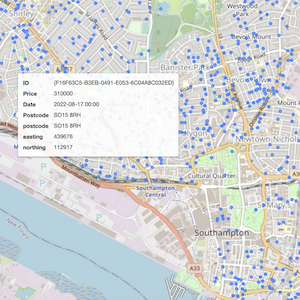
Introduction to Geospatial Data in Python
In this talk, I introduce geospatial data and how to process it using Python. I explain what geospatial data is, and what makes it different from normal data. I cover the types of geospatial data, issues relating to co-ordinate systems, and where to get geospatial data, before diving into a couple of case studies of geospatial data processing with Python using libraries including GeoPandas, rasterio, shapely, rasterstats, folium and more.
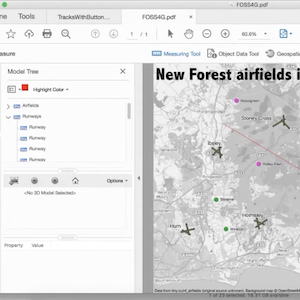
From static PDFs to interactive, geospatial PDFs
You’ve almost certainly used the PDF format to store a map visualisation before - but did you know that PDFs aren’t restricted to static data? Using Geospatial PDFs you can build interactive PDFs in which layers can be switched on and off, data and locations can be queried, and data can even be re-loaded back into a GIS system. This talk will introduce these features, before going far further and building an interactive ship track exploration tool in a PDF file.
Writing Python to process millions of rows of mobile data – in a weekend
In April 2015 there was a devastating earthquake in Nepal. I was given the unenviable task of processing millions of rows of mobile phone call records to extract preliminary information on population movement - all in a weekend! This talk is the story of how I wrote Python to do this, and what can be learnt from my experience.

School lessons/talks
Decentralised systems, complexity theory, self-organisation and more
This talk/lesson is very similar to my complex systems talk described above, but is altered to make it more suitable for use in schools. So far I have run this as a lesson as part of the International Baccalaureate Theory of Knowledge (TOK) course, but it would also be suitable for A-Level students studying a wide range of subjects.
GIS/Remote sensing for geographers
I’ve run a number of lessons for sixth form geographers introducing them to the basics of GIS and remote sensing. These topics are often included in the curriculum for A-Level or equivalent qualifications, but it’s often difficult to teach them without help from outside experts. In this lesson I provide an easily-understood introduction to GIS and remote sensing, taking the students from no knowledge at all to a basic understanding of the methods involved, and then run a discussion session looking at potential uses of GIS/RS in topics they have recently covered. This discussion session really helps the content stick in their minds and relates it to the rest of their course.

Computing
As an experienced programmer, and someone with formal computer science education, I have provided input to a range of computing lessons at sixth-form level. This has included short talks and part-lessons covering various programming topics, including examples of ‘programming in the real world’ and discussions on structuring code for larger projects. Recently I have provided one-on-one support to A-Level students on their coursework projects, including guidance on code structure, object-oriented design, documentation and GUI/backend interfaces.
